pathamid
Background to Pyramidology
This page briefly describes some of the history and ideas that came out of pyramidology. More detail may be found in books dealing extensively with the subject. (See also Bibliography)
The enigma of the Great Pyramid
The Great Pyramid stands on the Giza plateau. Its date of construction is believed to be from around 2500 BCE. It is generally held to have been built for the fourth dynasty pharaoh Khufu.
The Pyramid was built to the highest imaginable specification, but today exists in a deteriorated condition. Despite despoliation of the outer casing it is sufficiently intact to provide evidence of its design and precision workmanship. Among the many remarkable and puzzling features are its mathematical relationships, the shafts built into it that now provide ventilation, and an upper system of chambers and passages that are unique in pyramid building. Of all the pyramids of Egypt the Great Pyramid of Giza is the largest in mass and possesses the most complex passage system.

The underlying principle behind the Great Pyramid's construction is seen as an ancient Egyptian affirmation of life after death. The most widely accepted belief holds that it was built as a tomb for the Pharaoh Khufu to assist his passage to the afterlife, but lacking evidence of any burial the enigma of the Great Pyramid remains unresolved. With questions largely unanswered about its method of construction, unique features and mathematical properties, the mystery over its purpose and meaning has endured.
The opening of the Pyramid
Evidence of Roman smoke inscriptions found in the Subterranean Chamber means the entrance must have been known at that time, but after Roman rule in Egypt ended this knowledge appears to have been lost and remained so until the ninth century CE.
In the year 813 CE, a forced entry was made into the passage system of the Great Pyramid of Giza.
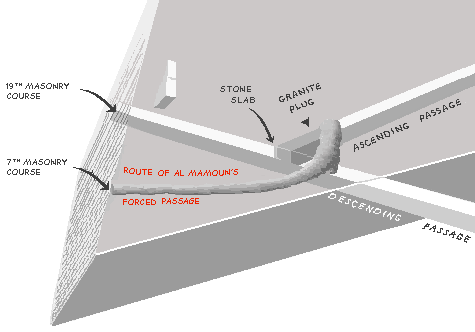
The generally accepted account of the opening tells how Al Mamoun, the Caliph of Baghdad, was determined to uncover the secrets and treasures of the Great Pyramid. Entrances to ancient Egyptian sites were typically to be found on the north side, and this he must have learned since he set his men to begin tunnelling at the centre of the north face and between the fifth and seventh courses of masonry. The story goes that after much effort the men were about to give up when they heard the sound of a falling object from deep inside, alerting Al Mamoun's men to a hollow section in the interior and causing tunnelling efforts to be re-directed. The sound is believed to have come from a slab of stone that previously concealed the start of the First Ascending Passage becoming dislodged as a result of the excavations and falling into the Descending Passage below.
Al Mamoun's men finally stumbled upon the passage system, only to find their way to the upper parts blocked by hard granite. By tunnelling through the softer limestone around it they were able to gain access to the ascending passageway beyond. It would have been a simple matter afterwards to locate the true entrance, offset to the east and several courses higher than guessed by Al Mamoun.
Today's visitors use his tunnel to gain entry into the Pyramid, but for Al Mamoun and his men luck had run out. Reportedly, there was no treasure, no inscriptions, or store of hidden knowledge, not even funeral remains to be found. Any secrets the Great Pyramid might hold would lie unsuspected and unfathomable until pyramidologists got to work in the 19th century.
Pyramidology
In the 19th century, people making a study of the Great Pyramid had become intrigued by its mathematical properties (not covered in these pages). They began to form ideas about its purpose and origins.
The earliest investigators in the field were John Taylor, Piazzi Smyth (Astronomer Royal for Scotland), Sir Flinders Petrie,1 the Edgar brothers, Robert Menzies, David Davidson, and many other enthusiastic seekers for answers to the enigma of the Great Pyramid. The sum of knowledge would be added to later by a new generation of pyramidologists, Adam Rutherford and Peter Lemesurier.
Proponents of the new science measured and explored the Pyramid, identifying its association with pi and the solar year, and investigating a connection to Christian beliefs. The units of measure (cubits) used in its construction were identified, as well as a small inch-like unit. It was with the smaller unit called the 'Pyramid inch' that certain associations began to be made. A claim was made that the passages contain a dating system: a perception partly based on, and illumined by, a small triangular feature built into the geometry of the First Ascending Passage, which they termed Messianic.2
The philosophy held by the early pyramidologists was based on the idea that God first set out his plan for the earth, and the Great Pyramid was designed, either by God or by man, to contain the plan. Then, sometime after the dawn of civilisation, the designed Pyramid was built at the centre of the inhabited world as a prophetic monument and repository of divine knowledge. It must be added that at first hearing such ideas seem fanciful, finding little favour today. It is the hope of this website, however, to prompt a new investigation into them, and the connection formed by Hebrew writers with the Great Pyramid.
Pyramidology today
The early pyramidologists were dedicated men working with controversial ideas that generated much excitement in their time and some unsubstantiated claims. The new field of study, ignored for the most part by experts in the field of Egyptology, has gradually lost its hold on popular interest as new ideas remain mostly speculative, leaving the enigma of the Pyramid unresolved. Jack Edwards' ideas are a new step forward, and in the light of his discoveries it is time for a new evaluation of the subject.
Path through the Pyramid is intended as a public introduction to these ideas. Its task is to read the internal witness of the Pyramid through gematria taken from Genesis.
O you Great Ennead, which is in Õn [Heliopolis], make the King's name endure; make this pyramid of this King and this construction of his endure for ever
Utterance 601
The Ancient Egyptian Pyramid TextsO great and mighty God, the Lord of Hosts is his name, great in counsel, and mighty in work…who has set signs and wonders in the land of Egypt, even until this day, and in Israel, and among other men, and has made you a name as at this day.
Jeremiah 32:18-20
Footnotes
1
'Father of Archaeology' and founder of modern Egyptology, Petrie
would later discount pyramidology's claims.
2