pathamid
Notes and bibliography
1. General information
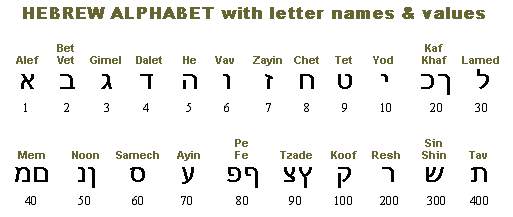
Gematria. A traditional Jewish method for interpreting Hebrew scripture
and finding relationships with other texts.
A gematria is derived from the sum of a given Hebrew text: either from a single
word-sum by adding together all its Hebrew letter values, or from a group of word-sums
whose constituent parts are added together in unbroken sequence. 1
(i) Example single word-sum gematria:

First occurrence gematria. A way of finding texts for Pyramid features that confers primacy as well as meaning upon dimensions. Correlating a Pyramid measurement with the first equivalent sum in Hebrew scripture was made possible by means of a computer-generated list of location references. 2
(ii) Example first-occurrence gematria for length of First Ascending Passage

Standard search numbers, or significant names. Special note
is taken of the following numbers when found as a Pyramid dimension, or as factor of a dimension.
It is thought they point to Pyramid features of special significance; each number
signifying an aspect of God was seen as remarkable for its place in the passage system.
The search numbers are listed below, but see books by Jack Edwards for full exposition of
their meaning and appearances in Genesis and other books of the Hebrew testament.
Arithmetic sequence
97 Equivalent to ben adam (Ezekiel 36:1)
197 Equivalent to immanuel (Isaiah 7:14)
297 Equivalent to dabar ha-elohim (1 Kings 12:22),
(297 x 6)
appearance as Image of God (Gen.1:27 a-i)
397 Equivalent to jehoshuah (Judges 2:7, Zechariah 3:3)
Other signifiers
143 Equivalent to ben ha-elohim (not found in Hebrew writings)
153 First Genesis appearance
(x2) as ruach elohim, 'Spirit of God' (Gen.1:2 i-j),
(153 x 1)
beni ha-elohim (Gen.6:2),
(153 x 4)
berith, 'covenant' (Gen.26:28)
358 Equivalent to mashiach,
'Messiah' (Daniel 9:26) 3
365.24 A pyramid standard
Information sources
Authorship of Genesis. There is a seeming anachronism of time and culture that has to be accounted for when associating Genesis with the Great Pyramid, but it should come as small surprise a Hebrew writer could have known the Pyramid in great detail for we are reminded that Moses, whose training and upbringing were Egyptian, is traditionally held as the author of Genesis. 4
Genesis texts, chapters 1-4. These are taken from
an interlinear translation from the Hebrew into English by S.P. Tregelles, LL.D. (1813-1875). The
lower-case letters appearing with a Genesis reference mark the position in verse of a specific textual
location.
Deviations from the Tregelles text occur where the Hebrew verb
suggests an uncompleted action. This is usually rendered in the past tense by
Tregelles, but is represented here by English futures will and shall.
Other deviations from the Tregelles text appear where preference is sometimes
given to the English masculine pronouns he/him instead of it.
These pronouns may be seen as interchangeable since Hebrew has no neuter gender.
Older forms such as thou (you) and art (are) have been
replaced by modern forms. A version of the Tregelles text can be found at this link:
Genesis 1-4 (gentext.pdf)
Pyramid measurements. Measurements in these pages will be shown in Pyramid inches.
They are taken, or derived from the work carried out by Adam and James Rutherford, whose precise
calculations are frequently shown in Pyramid inches to four decimal places. (Imperial and
metric dimensions are approximate and offered for comparison only)
1 Pyramid inch = 1.001064 British inches, or 25.4270256 millimetres
Diagrams and graphic representations are not drawn to scale unless
otherwise stated.
Other sources. Some references are made to other biblical texts where they looked appropriate to occasion. Sources quoted are from works by H J Edwards, the pyramidologist Adam Rutherford, and Egyptologist Sir William Flinders Petrie. Occasional references are made to utterances taken from Dr R.O. Faulkner's book, The Ancient Egyptian Pyramid Texts.
2. Pyramid base. Measures and theories
A. Rutherford and H.J. Edwards
(Part 6, footnote 4)
Readers will be able to imagine the difficulties involved in measuring the base perimeter of the Great Pyramid over such a large dilapidated exterior, and how difficult it would be to achieve a precise measurement. But it is one thing to measure such a base accurately, and quite another to know what the exact measurement was intended to be. Even disallowing such things as builders' error, there would have been settlement and distortion from time and earthquake, even in a structure as finely built as this.
Early estimates believed the base to be an exact 36,524 Pyramid inches.
When Egyptologist Sir Flinders Petrie surveyed the Great Pyramid's base perimeter in 1883, he measured its four sides. His measurements gave a mean baseline of side 9068.8 ± 0.5 British inches, or 9059.2 Pyramid inches (Pins). This last figure multiplied by four would give a total of 36,237 Pyramid inches for the whole base. The accuracy of Petrie's work has never been seriously disputed and it demolished the previously held theory of a 36,524-Pin base-perimeter.
In 1925 J.H. Cole made a survey of the Great Pyramid for the Egyptian government, giving 9069.4 British inches as mean baseline of side. Peter Lemesurier notes that Cole suggests an average tolerance of 1.25 inches per side. Cole's figures produce a total base of 36,277.8 British inches, which Lemesurier converts to 36,239 Pyramid inches. 5
In keeping with other pyramidologists, Adam Rutherford saw the Great Pyramid as a Bible constructed in stone. He marvelled at the closeness of the Petrie and Cole figures and he took the mean of their measurements for his base. He advanced the case for his new base by arguing that an ideal Pyramid would have been designed to a full 36,524-Pin base, but was purposely constructed to fall short by 286 Pyramid inches, the same amount by which the entrance and passage system centre-line is displaced from the Pyramid's north-south axis. His theory would mean the Great Pyramid was actually built with a base perimeter of 36,238 Pyramid inches, a little over one inch longer than Petrie's measurement but within Petrie's tolerance. Rutherford saw 286 both as a displacement and rectification figure representing mankind in relationship to God. (His idea of 36,524 as a perfect foundation would have accepted the 397 signifier as a factor.)
While working on his last book, Jack Edwards theorised that the builders contemplated more than one base-design for the Great Pyramid and he finally came to favour a pyramid designed to have a base-perimeter of 36,234 Pyramid inches: a base exactly divisible by standard number 297, representing the suffering One, the Image and Word of God. The arguments given will be found in his book The Great Pyramid. The Moses Connection.
This new base would cause fractional changes to some of Rutherford's theoretical measurements and the reason why both views are represented here. While preparing this presentation and believing it right to preserve some meaningful gematria found around the entrance the decision was made to stay with the 36,238 Rutherford base.
Whatever is finally determined as the build-design for the Pyramid base, it is hoped this divergence of opinion will not deflect attention from the important theory of biblical standard numbers and connection formed by Hebrew writers with the Great Pyramid of Giza. His arguments lend substance to Jack's theory that the builders originally considered more than one pyramid design, a premise that may provide deeper insights into the designer's intentions.
3. Inch-year and Scored Lines
(Background to Pyramidology, footnote 2)
Rutherford gives precise dates for the passage system in Books I, II and III of his four-volume work, Pyramidology.
- Beginning of Entrance Passage (commencement of building project)
"Summer Solstice, 22nd June (14th July, Julian) of 2623 B.C." and "end of Peret, the harvest season" - Scored Lines in Entrance Passage
"the datum-line or year of reference in respect of chronological measurements—the precise point of time being midday, 21st March, 2141 B.C., Gregorian (Vernal Equinox) at the longitude of the Great Pyramid (Long.31°9'0"E.)." - Beginning of First Ascending Passage and date proposed for Exodus
"1452.758 B.C. expressed in solar years, i.e. 30th March, 1453 B.C. (Gregorian Calendar)." - Beginning of Triangle, north end
"29th September Julian (27th September Gregorian), 2 B.C." - Beginning of Grand Gallery and south end of Triangle, a distance on sloping floor equal to
33.5116 Pyramid inches from the north end of Triangle
"3 p.m., 1st April Gregorian (3rd April Julian), A.D. 33, Jerusalem time." - Length of Grand Gallery roof line from north to south, 1835.6118 in solar years
"14th May (Julian) A.D. to the Winter Solstice on 21st December, A.D. 1868." - End of Gallery's sloping floor, 1812.47832 solar years (Pyramid inches)
"7.13 a.m. on the 23rd September Gregorian, A.D. 1845, Jerusalem time." "Autumnal Equinox" - Length of Grand Gallery floor line from north to south wall, 1881.2223 in solar years
"1st of April (Gregorian), A.D. 33, to the Summer Solstice, 22nd June, A.D. 1914"
"The Great Pyramid's chronograph is ascertained and established by astronomy and geometry. In Book I, pages 89-98, it is shown how the dating of the position of the Scored Lines in the Entrance Passage is astronomically fixed at the Vernal Equinox of 2141 B.C. by means of the star a Draconis. [6] As the scale of the general chronograph is a Pyramid inch to a year, it is simply a matter of measuring from this point, at the rate of an inch to a year, to the beginnings and endings of passages, etc., to ascertain the dates respectively represented thereby. So far as the features within the masonry of the Pyramid are concerned, the practical measurements are sufficient to arrive at the respective years denoted by the various points, but of course by such a method it is not possible to obtain the precise month or day. A day is represented by approximately the 1/365 part of an inch and one could not measure to that high degree of precision with certainty in stone, especially in a building so very old. The lengths of the passages have not been affected more than a fraction of an inch by earthquake and subsidence, except in that portion of the Descending Passage that lies in the natural limestone rock below the Pyramid masonry. (More details are given in Chapter XXV.)" Adam Rutherford
Pyramidology, Book III, page 939
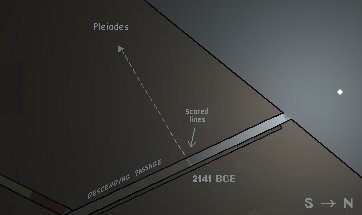
Representational view of a Draconis
Books consulted
Sources and references on scriptural Hebrew and English
- Bullinger, E.W. (1894), Number in Scripture. Reproduced from first edition by Kregel Publications, Grand Rapids, Michigan, 1967.
- Comey, A. and Tsur, N. (2000), NTC's Hebrew and English Dictionary. NTC Publishing Group, Lincolnville (Chicago).
- Edwards, H.J. (1991), Gematria: a long lost key to the Bible and to the Creation stories. Estate of H.J. Edwards. Published by Edwards Family.
- Gesenius, W., A Hebrew and English Lexicon of the Old Testament: based on the lexicon of William Gesenius, as translated by Edward Robinson. Published by Clarendon Press & Oxford University Press. Reprinted 1951.
- King James Version, The Holy Bible. Oxford University Press, London.
- Magil, J. (1899), 'The Five Books of Moses', Magil's Linear School Bible, Hebrew and English Translation. Published by the Hebrew Publishing Company, New York.
- Snaith, N.H.
 [Book of the Law, Prophets and Scriptures]. Volume also
includes the New Testament, translated by Professor Franz Delitzsch from the Greek into
Hebrew. Published by The Bible and Foreign Bible Society, London, 1958.
[Book of the Law, Prophets and Scriptures]. Volume also
includes the New Testament, translated by Professor Franz Delitzsch from the Greek into
Hebrew. Published by The Bible and Foreign Bible Society, London, 1958. - Tregelles, S.P., The Hebrew Students' Manual. Published by Samuel Bagster & Sons, London. [Out of print]
- Weingreen, J. (1939), A Practical Grammar for Classical Hebrew. 2nd Edition. Published by Oxford University Press, Oxford. Second edition, 1959.
- Young, R. (1879), Analytical Concordance to the Holy Bible. 8th Edition, revised (1939). Published by the United Society for Christian Literature, Guildford and London. Reprinted 1975.
Sources and references for Ancient Egypt and Great Pyramid
- Cerny, J., Professor of Egyptology, University of Oxford, Ancient Egyptian Religion. Published by Hutchinson & Company, 1952.
- J.H. Cole, F.R.G.S, Inspector (Computation Office) SURVEY OF EGYPT, PAPER No.39: Determination of the Exact Size and Orientation of the Great Pyramid of Giza. Government Press, Cairo, 1925.
- Edgar, John & Morton (1910), (VOL.1) The Great Pyramid Passages. Published by Watchtower Bible & Tract Society
- Edwards, H.J. (1991), (1) Gematria; (2) The Stone; (3) Appendices for Gematria and The Stone. Published by Edwards Family.
- Edwards, H.J. (1995), The Great Pyramid: The Moses Connection. Published by Edwards Family.
- El Mahdy, Christine, The Pyramid Builder: Cheops, the Man Behind the Great Pyramid. Published by Headline Book Publishing, London, 2003.
- Faulkner, R.O., The Ancient Egyptian Pyramid Texts 1910. Translated into English by R.O. Faulkner. Oxford at the Clarendon Press. Kessinger Publishing.
- Gahlin, Lucia, The Myths and Mythology of Ancient Egypt: a comprehensive guide to the mysteries of creation life and death. Published by Southwater (an imprint of Anness Publishing Ltd, London). 2003 edition. Previously published as part of larger compendium, Egypt: Gods, Myths and Religion.
- Lemesurier, P. (1977), The Great Pyramid Decoded. Published by Element Books, Shaftesbury.
- Lemesurier, P. (1987), The Great Pyramid: your personal guide, from exploration to initiation. Published by Element Books, Shaftesbury.
- Lemesurier, P. (1999), Decoding the Great Pyramid. Published by Element Books, Shaftesbury.
- Petrie, Professor Sir W. M. Flinders, The Pyramids and Temples of Gizeh. 1st ed. London: Field and Tuer; New York: Scribner & Welford, 1883. Republished online at The Pyramids and Temples of Gizeh Online. Ed. Ronald Birdsall, 2003. Rev. December 2, 2008. Online reference to his work, by courtesy of Ronald Birdsall. www.ronaldbirdsall.com/gizeh/
- Rutherford, A. (1957), Pyramidology: the Science and Divine Message of the Great Pyramid, revealing the Divine Plan for our Planet. Published in four volumes by The Institute of Pyramidology, Harpenden, 1957, 1962, 1966, and 1970. [These volumes appear to be out-of-print.]
- Shetter, Tony L. Genesis 1-2 In Light Of Ancient Egyptian Creation Myths. Paper presented at the second annual Student Academic Conference held at Dallas Theological Seminary in April 18, 2005. Published online at www.bible.org/article/genesis-1-2-light-ancient-egyptian-creation-myths
- Smyth, P. (Edinburgh, 1880), The Great Pyramid: its Secrets and Mysteries Revealed. A reprint of 1880 edition, 1990 edition is published by Bell Publishing Company, New York.
- Tompkins, P. (USA copyright, 1971), Secrets of the Great Pyramid: Two Thousand Years of Adventure and Discoveries Surrounding the Mystery of the Great Pyramid of Cheops. Galahad Books, New York, and published by arrangement with Harper Collins Publishers, New York. ISBN: 0-88365-957-3
- Wallis Budge, E.A., The Book of the Dead: an English translation of the chapters, hymns, etc, of the Theban Recension. Published by Routledge & Kegan Paul.
- Watterson, B., Gods of Ancient Egypt. First published by Sutton Publishing Limited in 1984, London. 2003 edition.
- Wilkinson, Richard H., The Complete Gods and Goddesses of Ancient Egypt. Published by Thames & Hudson, 2003.
Other sources
- Hamilton, J. and M. (1993), Hamilton's Math to Build On. Online: (copyright) The Math Forum, 1994-2009 Drexel University. www.mathforum.org/sarah/hamilton/
- The Shorter Oxford English Dictionary (5th edition) on CD-ROM Version 2. Published by Oxford University Press, 2002.
- World Wide Web. Wikipedia, the free encyclopaedia.
Footnotes
1
The standard method for calculating gematria is used throughout.
Some words come joined by a makkaph (looks similar to a hyphen).
For gematria purposes it was considered that words so joined should not be separated but reckoned
as one word. A few exceptions were made to this rule where an interesting gematria resulted from a
split makkaph, the broken rule indicated in each case.
All texts applied to Great Pyramid measurements are grounded in these rules.
2
All numerical occurrences in Genesis chapters 1-4 were first determined by computer search.
All pyramid texts are from first occurrences, unless sttated otherwise.
Passage and other interior measurements are given in pyramid inches.
3
A pyramid measurement that came to Jack's attention, though not classed as a biblical standard.
It was added to this search after its several appearances suggested treatment as a Pyramid
standard. The same is true also for standard number 365.24.
4
Upbringing of Moses
And the child grew, and she brought him unto Pharaoh's daughter, and he became her son. And she called his name Moses. And she said, Because I drew him out of the water.
Exodus 2:10And Moses was instructed in all the wisdom of the Egyptians, and was mighty in words and deeds.
Words spoken by Stephen, Acts 7:22
5
The Great Pyramid Decoded, by Peter Lemesurier, Appendix B
6
Rutherford shows the Scored Lines, first noted by Prof. Piazzi Smyth, to be heralded on their
north sides by two 'unique joints, almost upright'. (Book III, p.956)